.png)
Best Smart Building Technology Platforms in 2026: Top 6 Tools Compared


TL;DR
- Smart building technology companies build software and connected hardware that lets property teams monitor, diagnose, and control building equipment remotely, instead of walking every floor to find what’s broken.
- They shrink the time between a failure starting and someone finding out, so an emergency truck roll turns into a scheduled visit. They also consolidate portfolio equipment status into one dashboard, so a manager overseeing multiple buildings does not have to log into five separate systems to see what needs attention.
- Common features across platforms include multi-property dashboards, remote setting controls, real-time fault alerting, setpoint boundaries, maintenance task tracking, and over-the-air firmware updates.
- SmartHQ™ Management extends coverage past thermostats into the appliances themselves, including Zoneline PTAC and VTAC units, commercial laundry, dryers, and water heaters. Technicians get real-time fault codes, fault frequency counts, and mini-manuals per appliance.
- Johnson Controls, Honeywell Forge, and Schneider Electric anchor the enterprise BAS side (central chillers, boilers, air handlers). Verdant and Telkonet EcoSmart round out the in-room tier alongside SmartHQ™ Management, with Verdant focused on hotel thermostat setback and Telkonet on Zigbee mesh retrofits for older buildings.
The Best Smart Building Technology Platforms in 2026
The leading smart building technology platforms in 2026 include SmartHQ™ Management, Johnson Controls (Metasys / OpenBlue), Honeywell Building Technologies (Forge), Schneider Electric (EcoStruxure), Verdant (Copeland), and Telkonet EcoSmart.
Each platform serves a different combination of building scale, asset class, equipment type, and operational workflow:
- Enterprise BAS platforms (Johnson Controls, Honeywell, Schneider Electric) focus on central plant automation, engineered controls, and campus-scale facility operations.
- In-room and in-unit platforms (SmartHQ™ Management, Verdant, Telkonet) focus on guest-room climate controls, distributed appliance management, and occupied-space maintenance efficiency.
This guide evaluates the leading platforms across control depth, equipment coverage, portfolio scalability, deployment models, and operational fit.
What is Smart Building Technology?
Smart building technology connects physical building equipment, sensors, and operational hardware to centralized software networks, enabling property teams to monitor performance, diagnose faults, adjust settings, and optimize energy remotely.
Core Functional Layers
- Physical & Connected Hardware: Chillers, air handlers, PTAC/VTAC units, water heaters, laundry machines, thermostats, and environmental sensors.
- Telemetry & Communication Layer: Wi-Fi, BACnet, or mesh protocols transmitting real-time operational data, power draw, and error codes.
- Centralized Management Dashboard: Cloud-based consoles organizing devices by portfolio, property, building, floor, and room.
- Action & Diagnostic Layer: Remote batch commands, fault code identification, task tracking, and firmware updates.
Primary Business Outcomes
- Operational efficiency: Reduced manual inspections and faster diagnostic workflows.
- Asset protection: Real-time monitoring and proactive alerts for leaks and critical temperature thresholds.
- Equipment longevity: Timely resolution of minor operational anomalies before component burnout occurs.
How Smart Building Technology Works
- Data Ingestion: Connected equipment and sensors continuously transmit status, temperatures, operating modes, and fault codes.
- Automated Processing: Cloud engines evaluate incoming telemetry against operating boundaries, generating alerts when deviations occur.
- Centralized Display: Facility teams review portfolio health across buildings, floors, and individual units from a unified interface.
- Remote Execution: Operators push batch setpoint updates, schedule firmware updates, or review diagnostic repair guides before dispatching technicians.
What Do the Best Smart Building Technology Tools Do?
Every viable platform supports a core set of baseline capabilities. Buyers should understand these shared features before evaluating vendor differentiators:
Core baseline capabilities every smart building platform supports, and what each one delivers operationally
Why List Common Features Separately?
Most enterprise and in-room platforms provide baseline dashboards and remote control. The critical buying distinctions lie in equipment coverage (HVAC-only vs. full appliance suites), control depth (read-only telemetry vs. remote parameter execution), and network deployment requirements.
How We Evaluated the Platforms
Our comparative evaluation uses a five-factor framework tailored to commercial and multi-unit property operations:
- Control Depth: Does the platform offer two-way parameter control and batch configuration, or is it limited to passive monitoring?
- Equipment and Asset Coverage: Does the system manage only central plant equipment, thermostats alone, or full in-unit appliance setups (laundry, water heaters, PTACs)?
- Deployment and Retrofit Feasibility: Can the system be deployed across existing occupied properties over standard wireless networks, or does it require specialized physical cabling?
- Diagnostic Depth: Does the platform supply component-level fault codes and technical documentation, or merely general alert notifications?
- Portfolio Scalability: How effectively does the platform structure data across hundreds of buildings, thousands of rooms, and multi-regional portfolios?
Data and Technical Review Sources
Platform architectures, networking requirements, and functional scopes were evaluated using official vendor technical documentation, engineering specifications, and public product releases.
Note: All property scenarios, facility sizes, and operational workflows mentioned in this guide are hypothetical and included for illustrative evaluation purposes.
6 Best Smart Building Technology Platforms at a Glance
The six platforms below cover the two tiers property teams buy against, i.e, enterprise BAS for central plant equipment, and in-room or in-unit platforms for the equipment sitting inside individual rooms and apartments. This table shows the tier each platform belongs to, the deployment it fits best, and how far its equipment coverage extends.
The 6 smart building technology platforms compared by tier, best-fit use case, and equipment coverage
1. SmartHQ™ Management: Best for Multi-Unit Properties Standardizing on GE Appliances
[Component 3: Product Highlight Card, navy]
Best for: Hospitality, senior living, multifamily, and student housing operators standardizing on GE Appliances who need unified HVAC and appliance intelligence.
Platform Overview
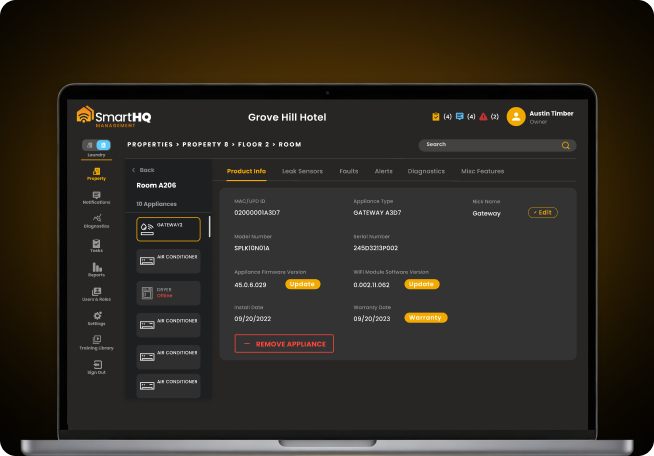
SmartHQ™ Management is GE Appliances' purpose-built connected property platform. It provides a centralized, cloud-based dashboard to manage, monitor, and service connected GE Appliances across multi-unit portfolios.
While conventional in-room platforms manage only the wall thermostat, SmartHQ™ Management brings the appliances themselves. Zoneline PTAC and VTAC units, commercial laundry machines, dryers, and water heaters into a single operational view. This allows facility teams to oversee room climate and unit appliances without toggling between separate systems.
What Makes SmartHQ™ Management Different
- Full In-Unit Equipment Coverage: Extends remote management and telemetry beyond HVAC to include washers, dryers, and water heaters.
- Batch Command Functionality: Pushes mode, power, and setpoint changes across hundreds of rooms or selected equipment groups in a single action.
- Native Diagnostic Depth: Provides real-time fault codes, fault frequency counts, and direct links to mini-manuals and service workflows so technicians understand component issues before entering a unit.
- Proactive Leak Alerts: Connects with paired GE Leak Sensors and Gateways to provide real-time alerts in wet areas.
Commercial Terms & Pricing
Pricing: Contact sales for current pricing.
Trial Availability: 90-day free trial access available for qualified property evaluations.
Things to Check Before Choosing SmartHQ™ Management
- Appliance Brand Standard & Compatibility: Optimized specifically for Wi-Fi-enabled GE Appliances. Properties with mixed legacy brands will monitor and manage the GE Appliance portion of their equipment.
- Wi-Fi Coverage: Requires a dedicated 2.4 GHz Wi-Fi network with a minimum signal strength of -85 dB at each appliance location.
- Security & Setup: Supports WPA/WPA2-PSK (WPA3-only and WPA2-Enterprise are not supported). Initial commissioning requires an iOS or Android device on site.
2. Johnson Controls (Metasys / OpenBlue): Best for Large Commercial Campuses
Best for: Large commercial real estate, healthcare campuses, universities, and facilities with complex central mechanical plants.
Platform Overview
Johnson Controls is a global leader in enterprise building automation. Centered on the Metasys BAS and the OpenBlue cloud architecture, the platform coordinates central chillers, air handlers, variable air volume (VAV) systems, and facility power distribution.
The platform excels in facilities where mechanical systems are centralized and require ongoing supervisory control, sequence optimization, and deep energy analytics.
What Makes Johnson Controls Different
- Central Plant Depth: Sophisticated sequence-of-operation control for large chiller and boiler installations.
- OpenBlue AI Analytics: Continuous monitoring of central plant efficiency, predictive chiller maintenance, and occupancy-based plant loading.
- Enterprise Security Integration: Native coordination across access control, video surveillance, and fire safety systems.
Commercial Terms & Pricing
Pricing: Custom, integrator-quoted engineered systems based on facility square footage, point counts, and mechanical architecture.
Things to Check Before Choosing Johnson Controls
- Deployment Scope: Engineered for central plant infrastructure; not intended for decentralized, through-the-wall in-unit equipment such as PTACs.
- Implementation Overhead: Requires certified systems integrators for engineering, wiring, and commissioning.
3. Honeywell Building Technologies (Forge): Best for Multi-Site Commercial Estates
Best for: Regulated commercial portfolios, airports, data centers, and multi-site commercial enterprises requiring portfolio benchmarking.
Platform Overview
Honeywell pairs legacy field controllers with Honeywell Forge, an enterprise performance management software. Forge ingests operational technology data across geographically distributed estates to deliver energy benchmarking, predictive maintenance analytics, and compliance tracking.
What Makes Honeywell Forge Different
- Multi-Site Benchmarking: Normalizes building operational data across hundreds of locations to identify underperforming facilities.
- High-Complexity Environment Support: Designed to satisfy stringent regulatory and uptime requirements for data centers and life-science facilities.
- Asset Health Modeling: Uses operational models to track degradation in large mechanical components.
Commercial Terms & Pricing
Pricing: Enterprise annual subscription tailored to portfolio point counts and facility profiles.
Things to Check Before Choosing Honeywell Forge
- Data Density Requirements: Delivers maximum value when deployed across large, heavily instrumented commercial buildings.
- Administrative Demands: Requires dedicated facility engineering staff to act on complex fault detection and diagnostic data.
4. Schneider Electric (EcoStruxure): Best for Mixed-Vendor Commercial Facilities
Best for: Commercial portfolios with diverse, multi-generation building equipment requiring open-protocol integration.
Platform Overview
Schneider Electric's EcoStruxure Building Operation is an open, BACnet-certified building management solution designed to connect HVAC, power management, lighting, and security infrastructure into a unified supervisory console.
Its primary strength is bridging disparate hardware generations and multi-vendor mechanical configurations across commercial campuses.
What Makes Schneider Electric Different
- Native Multi-Protocol Interoperability: Native support for BACnet, LonWorks, Modbus, and KNX communication standards.
- Integrated Power & Energy Management: Deep synchronization between building HVAC loads and electrical distribution monitoring.
- Scalable Modular Hardware: Field controllers scale from single commercial floors up to high-density commercial towers.
Commercial Terms & Pricing
Pricing: Engineered quote model based on hardware controllers, software licensing tiers, and commissioning support.
Things to Check Before Choosing Schneider Electric
- Engineering Complexity: System configuration, graphics creation, and point mapping require certified engineering expertise.
- Operational Fit: Suited for commercial building operations rather than distributed residential or hotel room management.
5. Verdant (Copeland): Best for Hotel Guest-Room HVAC Energy Management
Best for: Select-service and full-service hotel operators focused strictly on guest-room climate efficiency.
Platform Overview
Verdant (part of Copeland) focuses specifically on hospitality guest-room energy management. Its Thermostat Manager platform combines intelligent occupancy sensing, dynamic setback algorithms, and temperature limiting to reduce guest-room HVAC runtimes when rooms are unoccupied.
What Makes Verdant Different
- Hospitality-Specific Setback Algorithms: Adjusts recovery timing dynamically based on exterior temperatures to ensure guest comfort upon return.
- Broad HVAC Compatibility: Supports standard hospitality PTACs, VTACs, and VRF systems across major manufacturers.
- Brand Approvals: Pre-approved by multiple global hotel franchise brands, simplifying property approval cycles.
Commercial Terms & Pricing
Pricing: Hardware purchase per thermostat + an ongoing software and support subscription.
Things to Check Before Choosing Verdant
- Coverage Limits: Focuses strictly on room thermostats; does not monitor or alert on water heaters, laundry, or kitchen appliances.
- Diagnostic Scope: Reports thermostat connectivity and room temperature status, but does not provide component-level appliance diagnostic codes.
6. Telkonet EcoSmart: Best for Older Hospitality Portfolios Requiring Wireless Mesh
Best for: Historic or older hotel properties where physical wiring cannot be installed across guest rooms.
Platform Overview
Telkonet's EcoSmart platform provides in-room automation and energy control through a self-healing Zigbee wireless mesh network. It links room thermostats, occupancy sensors, lighting controls, and plug loads back to a central management console without requiring dedicated network cabling between individual room devices.
What Makes Telkonet Different
- Zigbee Wireless Mesh Architecture: Devices communicate peer-to-peer, minimizing required network drops and avoiding cable installation in occupied rooms.
- Room-Level Device Coordination: Synchronizes lighting, plug load circuits, and thermostats to setback modes upon room vacancy.
- Non-Invasive Retrofitting: Rapid physical installation suitable for older buildings with solid plaster or masonry construction.
Commercial Terms & Pricing
Pricing: Per-room hardware packages + tiered software licensing.
Things to Check Before Choosing Telkonet
- Appliance Diagnostic Depth: Manages device power draw and environmental states, but does not provide component-level error diagnostics for heavy appliances.
- Mesh Topology Management: Requires careful physical gateway placement to ensure reliable mesh signal propagation across thick building structures.
Technical Comparison Matrix
Here’s how each platform differs under the hood, across six technical dimensions.
The 6 platforms compared across six technical dimensions, from HVAC control level to primary wireless technology
Who Needs Smart Building Technology?
Commercial building and multi-unit property operations face increasing labor constraints and rising utility expenses. You likely need a smart building management platform if:
- Maintenance is reactive: Staff only learn about HVAC failures, water leaks, or appliance breakdowns when a tenant or guest complains.
- Manual floor walks drain staff hours: Technicians spend significant time manually walking properties to adjust seasonal temperature settings or inspect vacant units.
- Diagnostics happen at the unit: Technicians arrive at service calls without knowing the specific fault code or necessary replacement parts.
- Energy is wasted in unoccupied spaces: HVAC units run continuously in vacant rooms or turnover suites without centralized setpoint boundaries.
- Portfolios lack centralized visibility: Property managers overseeing multiple buildings have no unified dashboard to view equipment status or maintenance tasks.
How the Smart Building Technology Market is Changing in 2026
Three shifts have moved this category over the past couple of years, and they explain why the buying decision looks different now than it did five years ago.
- Separation of Central Plant vs. In-Unit Control: The market has moved away from "one-size-fits-all" systems. Facility operators recognize that central chillers require engineered automation, while guest rooms and living units require flexible, appliance-level visibility.
- Emphasis on In-Unit Diagnostic Depth: Basic remote on/off switches are no longer sufficient. Operators require component-level diagnostic codes and mini-manuals to streamline technician labor.
- Retrofit-First Architecture: With high construction costs, operators prioritize platforms that deploy over standard 2.4 GHz Wi-Fi or wireless mesh networks without requiring structural rewiring.
How to Choose the Right Smart Building Platform
The buying decision comes down to which equipment tier your operation carries exposure on, and whether the platform can run over the network you already have. Four steps get you there:
Step 1: Start With Your Primary Equipment Scope
- If your primary operational cost is central chillers, boilers, and primary air handlers, evaluate Enterprise BAS platforms (Johnson Controls, Honeywell, Schneider Electric).
- If your daily maintenance hours are spent addressing guest-room PTACs, water heaters, and laundry machines, evaluate In-Unit Platforms (SmartHQ™ Management, Verdant, Telkonet).
Step 2: Assess Equipment Coverage Needs
If your property operations encompass laundry machines, water heaters, and kitchen equipment alongside HVAC units, select a platform that provides native multi-appliance diagnostic intelligence rather than an isolated thermostat controller.
Step 3: Verify On-Site Network Readiness
For in-unit connected equipment, verify that your properties broadcast 2.4 GHz Wi-Fi with at least -85 dB signal strength at each appliance location, utilize IPv4 addressing, and support WPA/WPA2-PSK security.
Step 4: Evaluate Diagnostic Depth vs. Simple Monitoring
Simple telemetry informs you that a room is hot. Advanced diagnostic platforms provide the exact fault code, fault frequency, and repair steps so technicians arrive with the correct tools and replacement parts.
Network and Pre-Deployment Checklist
Before deploying connected smart building technology, confirm the following network specifications with your IT team:
- 2.4 GHz Frequency Broadcast: Verify property-wide 2.4 GHz Wi-Fi coverage (5 GHz is not supported for appliance connectivity).
- Signal Strength Verification: Measure signal strength at the exact appliance location (closet, exterior wall alcove), ensuring a minimum of -85 dB.
- Supported Security Protocols: Confirm support for WPA-PSK or WPA2-PSK. (WPA3-only networks and WPA2-Enterprise are not supported).
- IP Protocol: Verify IPv4 addressing across device VLANs.
- Firewall Ports & Permissions: Ensure network rules permit persistent TCP connections, outbound HTTPS traffic, and MQTT protocol communication.
- Captive Portal Bypass: Ensure device MAC addresses are bypassed on guest networks that utilize browser captive portal logins.
- Mobile Setup Device: Ensure maintenance personnel have an iOS or Android device connected to the local site Wi-Fi for initial hardware commissioning.
Why Consider SmartHQ™ Management?
SmartHQ™ Management is specifically engineered for property teams managing multi-unit portfolios equipped with GE Appliances.
Where SmartHQ™ Management Fits Best
- Unified In-Unit Oversight: Monitor Zoneline PTACs, VTACs, commercial laundry, and water heating systems within one portfolio dashboard.
- Reduced Room Disruptions: Batch commands allow staff to adjust seasonal setpoints and operational modes across hundreds of rooms remotely.
- Technician Efficiency: Technicians receive real-time fault codes and instant access to repair guides prior to entering occupied units.
- Proactive Leak Alerts: Paired sensors and gateways provide immediate alerts in water-sensitive areas to facilitate rapid response.
Early detection can reduce the likelihood that a minor equipment problem becomes an urgent, more disruptive repair. The actual cost impact depends on the fault, equipment condition, and how quickly the team responds.
Final Recommendation: Which Platform Should You Choose?
The one to buy is the one whose scope matches the equipment tier you carry the most exposure on. Here is the shortlist:
- Best for Multi-Unit Properties Standardizing on GE Appliances: SmartHQ™ Management provides the deepest native diagnostic visibility and portfolio-wide batch command capabilities across both HVAC and unit appliances.
- Best for Large Commercial Campuses & Central Plants: Johnson Controls delivers proven supervisory control and central plant energy optimization.
- Best for Multi-Site Commercial Benchmarking: Honeywell Forge provides powerful portfolio-level operational technology analytics across large, instrumented buildings.
- Best for Multi-Protocol Commercial Retrofits: Schneider Electric EcoStruxure excels at uniting disparate BACnet, KNX, and Modbus hardware under one system.
- Best for Dedicated Hotel Guest-Room HVAC Efficiency: Verdant delivers proven occupancy-based thermostat setbacks.
- Best for Older Hospitality Properties Without Wiring: Telkonet EcoSmart provides rapid wireless mesh deployment across existing spaces.
Still managing your entire appliance fleet without real-time visibility?
- Real-time monitoring and precision diagnostics across your portfolio
- Remote controls and batch commands without room-by-room visits
Portfolio-wide
Real-time
Real-time
monitoring & control