.png)
Hotel Sustainability Software: How to Cut Energy, Water & Waste Costs in 2026


TL;DR
- Hotel sustainability software falls into two broad jobs: measuring environmental performance, or improving the way a property uses resources day to day.
- ESG platforms handle portfolio reporting, and certification systems track progress against a defined standard, while operational platforms connect equipment data to controls and service workflows.
- The U.S. hospitality sector spends more than $7.3 billion on energy each year, so even small operational gains add up across a portfolio.
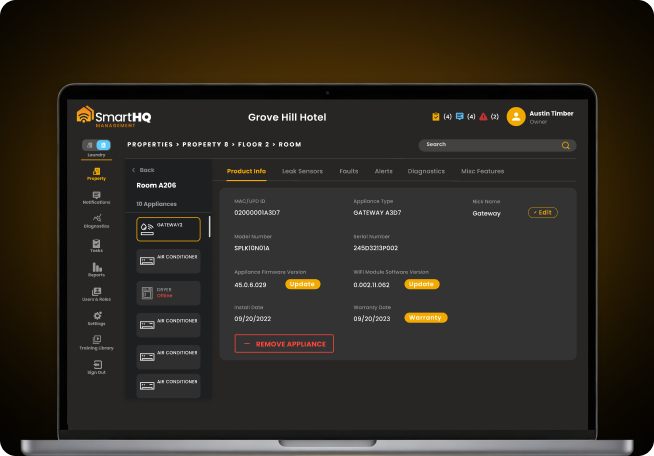
- SmartHQ™ Management brings monitoring, diagnostics, alerts, controls, reports, and task management for connected appliances into one workspace.
What is Hotel Sustainability Software?
Hotel sustainability software helps lodging businesses do one of two things: measure environmental performance, or improve how a property uses resources every day. Some products focus on reporting and certification, while others manage connected equipment on the floor.
The distinction matters because the two jobs serve different people. A corporate sustainability team needs consistent portfolio data it can compare year over year. Property teams work on a shorter clock, adjusting supported equipment and responding the moment an alert appears.
The scale of the category is easy to underestimate. The Cornell Hotel Sustainability Benchmarking Index draws on data from more than 27,000 hotels to benchmark energy, water, and carbon performance across the industry.
Market definitions vary because these products serve different users. Greenview concentrates on hotel ESG data and reporting, whereas EarthCheck pairs sustainability management with certification services.
SmartHQ™ Management sits in the operational category. It connects appliance information to controls and maintenance workflows, which is what turns a property signal into an assigned, trackable action.
How Hotel Sustainability Software Developed
Early hotel sustainability programs ran on utility bills and spreadsheets. Teams compiled annual totals and compared properties only after each reporting period had closed, so problems surfaced long after they started.
Cloud platforms changed the reporting side first. Sustainability leads gained shared dashboards and consistent data structures, and certification programs moved their assessments into digital systems around the same time.
Connected equipment then added an operational layer on top. Supported appliances can now send status information to a central workspace, where a team reviews the condition and assigns follow-up work. The value lives in that defined response, i.e., a report describes performance over time, but operational software helps staff act on a condition while it still matters.
What are the Main Hotel Sustainability Software Categories?
Hotel sustainability software splits into three categories, and each one answers a different question. Some products measure portfolio performance, some guide certification, and others drive property-level action.
Hotel sustainability software categories grouped by the work they support
1. ESG Measurement and Reporting Platforms
ESG platforms centralize portfolio data and make benchmarking straightforward. They help owners prepare environmental disclosures, and they let corporate teams compare results across properties in one view.
The category suits hotels where carbon accounting or formal reporting drives the program. Its main output is organized performance data, so equipment control usually calls for a separate operational platform.
2. Certification-Led Sustainability Platforms
Certification systems structure assessments around a defined standard, which helps teams document their actions and assemble certification evidence. Hotels tend to choose this category when external recognition is the goal.
The system guides progress against set criteria, but it does not handle daily equipment response. That remains a separate operating need, and it is worth budgeting for alongside the certification work.
3. Operational Appliance-Management Platforms
Operational platforms focus on execution at the property. SmartHQ™ Management lets teams monitor supported connected appliances, review real-time status, and receive alerts when something needs attention.
Remote diagnostics give the team equipment information before a service visit, and task management assigns each response an owner and a due date. Batch Command then applies a selected action across supported units at once.
How Operational Software Supports Hotel Energy Savings
Operational software supports energy savings by giving teams equipment visibility and consistent controls. It moves the conversation away from a single utility total and toward a specific action on a specific unit.
The financial stakes are real. ENERGY STAR reports that U.S. hotels spend roughly $7.3 billion on energy each year, and the average guest room runs close to $2,200 in annual energy costs.
Results are possible with a sustained program. Better Buildings hospitality partners have saved a combined $290 million since 2011 by applying energy and water measures across participating properties.
SmartHQ™ Management contributes on the operational side of that effort. Hotel teams can review the status of supported connected appliances remotely, and alerts flag the conditions that need a closer look.
Controls turn that visibility into policy. Temperature limits help a team hold an approved operating range, and Batch Command applies checkout or check-in settings across many rooms in one step. Actual savings still depend on equipment coverage and local operating practices.
How Water Monitoring Supports Faster Hotel Response
Water monitoring tackles two problems at once: detection that arrives too late, and alerts that no one clearly owns. Compatible sensors detect water at their placement points, and SmartHQ™ Management routes the alert to designated users.
Speed is what shapes the outcome. Early detection can reduce the likelihood that a minor equipment problem becomes an urgent repair, though the cost impact still depends on the fault and the equipment’s condition.
A complete workflow has four parts that hand off cleanly. The sensor identifies water, the platform sends an alert, a manager assigns a task, and the team records its response.
Consider a hotel laundry room as a hypothetical. A sensor beside a washer detects water after a supply connection starts leaking, engineering receives the alert, and a technician inspects the source before the problem spreads.
It helps to be precise about what this does. Leak detection monitors for water and alerts the team, and the inspection and repair that follow are what actually resolve it. The technology supports the handoff between detection and action rather than replacing it.
What Waste Reduction Means for Appliance Management
For appliance management, waste reduction is mostly about service activity and equipment downtime. Food waste and recycling are real priorities, but they need dedicated programs with their own measurements.
Better preparation is where the appliance side helps. Remote diagnostics can give a technician more information before dispatch, which may reduce unnecessary diagnostic visits and support a more informed repair decision.
Accountability is the other half. Task management routes work to the right employee after an alert, and it leaves managers with a record of how the response played out.
The pattern echoes the water example. Early detection can reduce the likelihood that a minor equipment issue becomes a disruptive repair, and results vary with equipment condition and response time.
Food waste sits in its own lane. The American Hotel & Lodging Association reports reductions of up to 38% within 12 weeks for Hotel Kitchen participants, but those results came from food-waste practices rather than appliance monitoring. Keeping the two separate helps operators pick the right tool for each cost category.
Traditional Sustainability Reporting vs. Connected Operations
The operating model shifts once equipment data starts feeding property workflows. Reporting stays essential for portfolio measurement, and connected operations adds a route from a current condition to a staff action.
The two outputs suit different roles. A sustainability lead might spot rising energy use in a monthly report, but an engineering team needs equipment-level information to investigate the cause.
Connected operations also changes how maintenance gets prepared. Remote diagnostics can surface current equipment information before dispatch, and task records preserve the response so it can be reviewed later.
Traditional sustainability reporting compared with connected operations across five dimensions
How SmartHQ™ Management Fits Hotel Sustainability Operations
SmartHQ™ Management for hospitality sits within the connected operations category. It applies monitoring and diagnostics to supported appliance fleets, and it provides reports and alerts alongside them.
The day-to-day view is portfolio-wide. A team can see connected-appliance information across properties, real-time diagnostic and troubleshooting reports support service preparation, and task management links each equipment condition to a documented response.
Product controls add a second capability on top of monitoring. Temperature limits can support an approved hotel policy, and Batch Command applies a selected action across compatible units at once.
Controls and energy reports answer different questions, so it helps to keep them apart. A control changes a setting, a report describes measured resource use, and buyers should confirm the data available for each appliance type.
A staged start keeps the risk low. A hotel can begin with a single floor, connect compatible equipment, define who owns each alert, and then measure response time and operating results against a baseline.
Deployment Requirements for Connected Appliances
A connected appliance project should start with site readiness rather than hardware. SmartHQ™ Pro specifies the following network requirements:
- Wi-Fi coverage: Site-wide 2.4 GHz coverage at appliance locations
- Signal strength: At least −85 dB at appliance locations
- Network protocol: IPv4
- Security: WPA or WPA2-PSK
- Commissioning: A compatible mobile device
- Leak monitoring: Compatible sensors and a gateway
Current product guidance excludes WPA3 and WPA2-Enterprise, so those networks will not support commissioning. Teams should test guestrooms, laundry areas, and mechanical spaces before they commission anything.
A network assessment gives the project a measurable starting point. The deployment team can find weak coverage and confirm the security configuration early, which keeps avoidable delays out of the rollout.
How Should You Evaluate Hotel Sustainability Software?
A useful evaluation connects the business goal to the data and workflow an action actually requires. Five questions cover most of what matters.
1. Which Decision Should the System Improve?
Define the decision before you review any features. The goal might be adjusting equipment settings or dispatching a technician, and reporting and certification each call for different evaluation criteria.
2. Which Assets and Resource Categories Need Coverage?
List the appliance models planned for the project, along with their locations and connectivity status. Then decide which energy or water measures you will use to judge the result.
3. Who Owns Each Response?
Assign every alert to a named role, with a priority and a due date attached. Document the completion path as well, so unresolved events stay visible instead of quietly aging out.
4. Can the Property Support Deployment?
Check network coverage and security first, then confirm sensor placement and gateway requirements. Build commissioning time into the rollout plan rather than treating it as an afterthought.
5. How Will the Hotel Verify Value?
Run a staged pilot against a clear baseline. Measure response time and equipment downtime, and review energy use wherever the data is solid enough to trust.
Buyer questions for evaluating hotel sustainability software
Ask for product evidence behind every expected benefit, and note which outcomes depend on equipment compatibility. Keep measured results separate from hypothetical scenarios when you compare vendors.
Benefits and Limitations of Hotel Sustainability Software
Hotel sustainability software earns its place when it improves a defined decision. Each category contributes something different:
- ESG platforms organize environmental data and structure portfolio reporting.
- Certification systems track progress against a defined standard.
- Operational platforms work at the property level, providing current equipment information and response workflows. Connected controls can hold consistent policies across compatible units, and alerts point staff at a specific condition.
Every deployment also runs into practical limits worth planning for:
- Hardware needs installation and commissioning before it produces anything.
- Connectivity affects how much data you actually get.
- Staff need clear ownership rules to act on what the system surfaces.
- Coverage is bounded by design. A point sensor detects water only where its probes sit, and an appliance platform reports on supported connected equipment rather than everything in the building.
Clear boundaries lead to better buying decisions. Before you commit, ask what the system measures, how often it reports, and which actions users can take, then test those capabilities under normal property conditions.
Hotel Sustainability Works Best When Data Leads to Action
Hotel sustainability software spans portfolio reporting, certification, and connected operations, and each category supports a different part of the program. No single layer covers all three jobs.
The strongest use cases share one structure. A property asset produces useful information, the right employee receives it, and a defined action becomes part of the operating record. That structure gives operators a practical way to evaluate technology in 2026. Start with the business decision, identify the signal it needs, and define the response before you select a tool.
For appliance fleets, SmartHQ™ Management offers a focused connected-operations approach. Hotel teams gain monitoring, diagnostics, controls, and task management in one place.
Still managing your entire appliance fleet without real-time visibility?
- Real-time monitoring and precision diagnostics across your portfolio
- Remote controls and batch commands without room-by-room visits
Portfolio-wide
appliance visibility
Real-time
monitoring & control