.png)
Smart Technology for Hotels: Revolutionizing Hospitality with IoT Solutions


Smart technology for hotels refers to the use of IoT-connected devices, automation systems, and data analytics platforms that personalize guest experiences, streamline operations, and improve energy efficiency. The global smart hospitality market, valued at approximately $39.25 billion in 2025, is projected to reach nearly $197 billion by 2033, growing at a compound annual growth rate of around 22%. This rapid growth reflects a fundamental shift: modern travelers now expect the same seamless, digital-first experience from hotels that they get from ride-sharing apps, online banking, and smart home devices.
This article explains how smart hotel technology works, what IoT solutions look like in practice, how hotel automation improves operations, and how appliance management platforms like SmartHQ Management help hotels centralize control over connected devices.
What Is Smart Technology for Hotels?
Smart technology for hotels is the integration of Internet of Things (IoT) devices, artificial intelligence, cloud platforms, and automation software into hotel operations and guest services. These technologies allow hotels to connect room controls, appliances, energy systems, security features, and housekeeping workflows into a single, data-driven ecosystem.
In practical terms, smart hotel technology includes devices like connected thermostats, automated lighting, voice-activated entertainment systems, digital room keys accessed via smartphone, and centralized appliance management dashboards. The goal is to reduce manual tasks for staff, personalize the guest experience without requiring human intervention at every step, and generate real-time data that helps hotel managers make better operational decisions.
According to Hospitality Net, nearly 70% of hotel guests now prioritize staying at properties that offer modern, user-friendly technology. Statista data shows that more than 82% of households are expected to have at least one smart home device in 2026, which means guests increasingly expect the same level of connectivity and automation in their hotel rooms that they have at home.
How Are IoT Solutions Used in Hotels?
IoT solutions in hotels use networks of interconnected sensors and devices to automate services, collect real-time data, and respond to guest needs without manual input. These devices communicate with each other and with centralized management systems to create a coordinated, responsive environment throughout the property.
Here is how IoT works across key areas of hotel operations.
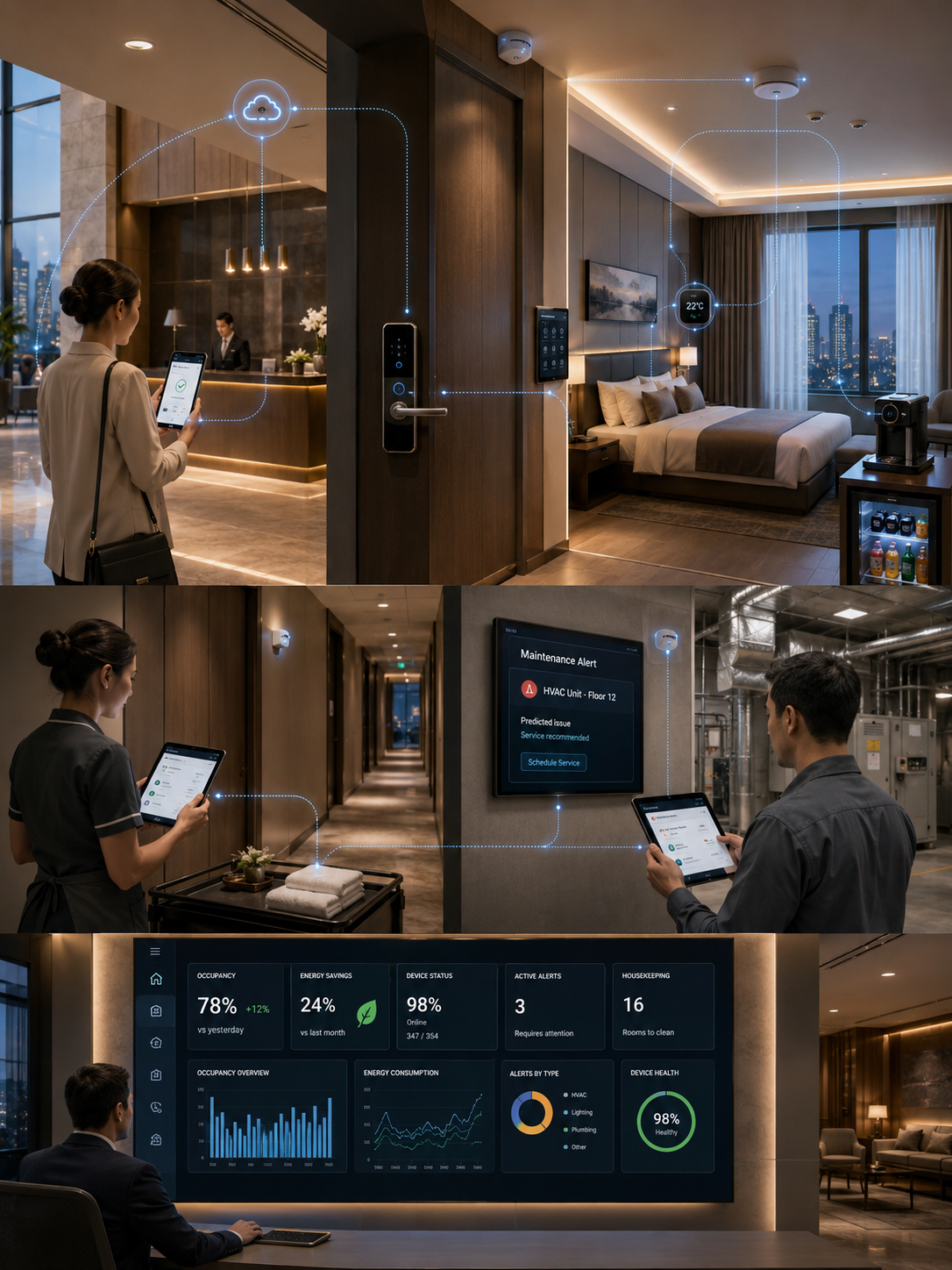
Smart room controls allow guests to adjust lighting, temperature, window blinds, and entertainment through a smartphone app, in-room tablet, or voice command. When a guest checks in, the room can automatically configure itself to their saved preferences, including temperature settings, lighting levels, and even preferred streaming services.
Occupancy sensors detect whether a room is occupied and relay that information to energy management, housekeeping, and front desk systems simultaneously. An unoccupied room can automatically reduce HVAC output and turn off unnecessary lighting, while housekeeping receives a notification that the room is available for cleaning.
Connected appliances such as coffee machines, mini-bars, and in-room safes can track usage, report malfunctions, and send data to a central management platform. For example, a smart mini-bar can log when items are removed and automatically add charges to the guest's bill.
Predictive maintenance sensors embedded in HVAC units, elevators, and kitchen equipment monitor performance metrics like temperature fluctuations, vibration levels, and energy consumption. These sensors flag early signs of wear, allowing maintenance teams to schedule repairs before equipment fails and disrupts the guest experience.
What Is Hotel Automation Technology?
Hotel automation technology refers to software and hardware systems that handle routine hotel operations with minimal human intervention. These systems use AI, IoT devices, cloud platforms, robotics, and data analytics to manage tasks ranging from check-in and checkout to energy management, housekeeping scheduling, and revenue optimization.
Automation in hotels works through interconnected systems that share data and trigger actions across departments. At the center of most setups, a property management system (PMS) or enterprise resource planning (ERP) platform serves as the command hub. This hub connects with IoT sensors, booking platforms, point-of-sale systems, maintenance scheduling tools, and guest-facing applications.
When a guest reserves a room, for example, the system automatically updates availability across all booking channels, sends a confirmation email, initiates pre-arrival room setup protocols, and personalizes the room configuration based on stored guest preferences. When the guest checks out via a mobile app, the system simultaneously updates housekeeping schedules, marks the room as available, processes payment, and triggers a post-stay satisfaction survey.
The key distinction between automation and traditional hotel operations is that automated systems are proactive rather than reactive. Instead of waiting for a guest to report a broken air conditioner, predictive maintenance flags the issue before it becomes noticeable. Instead of manually adjusting room rates, dynamic pricing algorithms recalculate in real time based on demand, competitor rates, local events, and historical booking patterns.
How Does Smart Technology Improve Hotel Operations?
Smart technology improves hotel operations by reducing manual tasks, speeding up service delivery, minimizing errors, and giving managers real-time visibility into every department. Here are the specific operational areas where smart technology has the greatest impact.
Guest Room Experience
Modern smart rooms eliminate the friction of unfamiliar controls and manual adjustments. Automated blinds, voice-activated entertainment systems, and intuitive climate controls configure themselves to each guest's preferences the moment they check in. Guests can manage every aspect of their room from a single smartphone app, including ordering room service, adjusting lighting, setting wake-up alarms, and requesting housekeeping.
This level of automation is increasingly expected rather than novel. With over 82% of households projected to own smart home devices in 2026, guests arrive at hotels already accustomed to voice commands and app-based controls. Hotels that fail to match this baseline risk negative reviews and lost bookings.
Appliance Security
Smart appliances integrate IoT-enabled security features that protect both guest belongings and hotel revenue. In-room safes can alert hotel security during tampering attempts. Connected mini-bars track authorized and unauthorized access, automatically flagging discrepancies. Smart locks provide digital key access through encrypted smartphone credentials, reducing the risk of lost or duplicated key cards.
Predictive Maintenance
Appliances equipped with smart sensors continuously monitor their own performance and predict when maintenance is needed. A coffee machine showing irregular heating patterns or an air conditioning unit drawing excessive power triggers an automated alert to the maintenance team. The repair gets scheduled before the equipment fails, which means guests always have access to functional amenities and hotels avoid the cost and disruption of emergency repairs.
Personalized Guest Experiences
Smart hotel systems use stored guest data to customize each stay. A returning guest might find their room pre-set to their preferred temperature, their coffee machine loaded with their usual brew setting, and their smart TV displaying recommendations based on past viewing history. Data analytics platforms identify patterns in guest behavior and preferences, enabling hotels to deliver this personalization at scale without requiring staff to remember individual details.
Housekeeping Optimization
Smart devices can notify housekeeping teams about room activity in real time. If a coffee machine is operated or a shower is running, the system flags the room as occupied so housekeeping avoids disturbing the guest. When occupancy sensors detect that a guest has left, cleaning teams receive an automatic notification with a prioritized schedule based on checkout times, room location, and staffing availability. This approach reduces wasted trips, optimizes cleaning routes, and ensures rooms are guest-ready faster.
What Are the Benefits of IoT in the Hospitality Industry?
IoT delivers measurable improvements across guest satisfaction, operations, revenue, and sustainability. Here are the six primary benefits.
Guest Satisfaction Through Personalization
IoT enables hotels to anticipate and respond to guest preferences automatically. Connected devices adjust room environments, recommend services, and streamline every touchpoint from check-in to checkout. According to a 2025 Skift and Oracle hospitality report, 77% of guests prefer automated messaging for quick communication, which indicates that most travelers actively want technology-mediated interactions when they are faster and more convenient.
Operational Efficiency and Cost Reduction
Automation eliminates bottlenecks and reduces the need for manual coordination between departments. Automated housekeeping scheduling, predictive maintenance, real-time inventory tracking, and dynamic staff allocation all contribute to leaner operations. Hotels with labor shortages, a persistent industry challenge projected to continue through at least 2035, benefit significantly from systems that allow smaller teams to maintain high service standards.
Data-Driven Decision Making
IoT devices generate continuous streams of operational data. Hotels can analyze this data to identify patterns in guest behavior, forecast demand, optimize pricing, and allocate resources more effectively. Real-time dashboards give managers immediate visibility into occupancy rates, energy consumption, maintenance needs, and revenue performance across all properties.
Energy Efficiency and Sustainability
Smart energy systems adjust HVAC, lighting, and power usage based on real-time occupancy data. Unoccupied rooms automatically reduce energy consumption. Connected sensors monitor water usage and waste levels. According to Booking.com's 2024 sustainability report, 75% of travelers surveyed want to travel more sustainably, making energy efficiency both a cost-saving measure and a competitive differentiator.
Competitive Advantage
Hotels that implement smart technology position themselves as modern, guest-centric properties. Tech-savvy travelers actively seek out hotels with digital check-in, smart room controls, and app-based services. Properties that adopt these features early attract a growing segment of digitally native guests and differentiate themselves in a crowded market.
Revenue Growth
Personalized services and real-time data create opportunities for targeted upselling and cross-selling. AI algorithms can analyze booking patterns, guest profiles, and availability to generate personalized upgrade offers at optimal moments, such as the morning of check-in or the evening before checkout. Dynamic pricing engines adjust room rates and ancillary service prices in real time to capture maximum revenue during high-demand periods.
How Does SmartHQ Management Help Hotels?
SmartHQ Management is an appliance management software platform that allows hotels to remotely monitor, control, and optimize a wide range of connected devices from a single centralized dashboard. It integrates with existing building management systems to provide real-time visibility into appliance performance, energy consumption, and maintenance needs across an entire property or portfolio of properties.
The platform is designed to solve a specific operational challenge: as hotels add more smart devices, managing them individually becomes impractical. SmartHQ Management unifies control over thermostats, lighting systems, smart TVs, laundry equipment, refrigeration units, and in-room amenities into one interface.

Core Capabilities of SmartHQ Management
- Remote monitoring and control enables hotel staff to adjust appliance settings from anywhere without entering guest rooms. If a guest requests a temperature change or a room needs to be preconfigured before arrival, staff can handle it remotely through the platform.
- Real-time energy consumption tracking provides granular data on which appliances consume the most power, when peak usage occurs, and where energy-saving measures will have the greatest impact. Hotels can use this data to reduce utility costs and meet sustainability targets.
- Predictive maintenance alerts notify staff when appliance performance data indicates an impending issue. Rather than waiting for a device to fail, maintenance teams receive advance warnings and can schedule service during low-occupancy periods to minimize guest disruption.
- Guest preference pre-configuration allows rooms to be set up according to stored guest profiles before arrival. Temperature, lighting, entertainment settings, and other appliance states can be adjusted remotely so the room is ready the moment the guest walks in.
- Integration with hotel SaaS products ensures SmartHQ Management works alongside existing property management systems, booking platforms, and other operational software. Data flows between systems without manual entry, reducing errors and maintaining consistency.
- SmartHQ Service, a companion tool, provides real-time troubleshooting and diagnostics for connected appliances. When an appliance reports an error, the platform can identify the specific issue, suggest a fix, or automatically dispatch a service request, reducing downtime and maintaining uninterrupted guest experiences.
- Data insights and reporting give hotel managers detailed analytics on appliance usage patterns, peak demand periods, and operational trends. These insights support informed decisions about equipment replacement cycles, energy-saving initiatives, and service improvements.
The fusion of smart technology, IoT solutions, and SmartHQ Management has the potential to revolutionize the hospitality industry. By embracing these innovations, hotels can deliver unprecedented guest experiences, optimize operations, and contribute to environmental sustainability. As technology continues to evolve, the future of hospitality is undoubtedly smart, efficient, and guest-centric.
What Is the Future of Smart Technology in Hotels?
The future of hotel technology is moving toward fully connected, AI-driven properties where every system communicates and adapts in real time. Several trends are shaping this direction.
- AI-powered predictive personalization is evolving beyond basic preference storage. Machine learning models are beginning to anticipate guest needs before check-in by analyzing booking patterns, past stays, and external data like travel purpose and group composition. The result is a stay that feels individually tailored without the guest needing to make explicit requests.
- Robotics and automated service delivery are expanding beyond novelty into core operations. Delivery robots handle room service, amenities, and housekeeping supplies. Cleaning robots manage repetitive floor and surface tasks. AI-powered voice assistants serve as virtual concierges that can answer complex guest questions, make reservations, and coordinate service requests across departments.
- Sustainability-focused automation is becoming a baseline expectation rather than a premium feature. Smart HVAC systems, LED lighting that responds to occupancy sensors, water monitoring, and digital replacements for paper menus, directories, and forms are all reducing hotels' environmental footprint while lowering operational costs.
- Cybersecurity and privacy infrastructure is growing in importance as hotels connect more devices and collect more guest data. Zero-trust security models, biometric authentication, encrypted digital payment systems, and AI-based threat detection are becoming standard components of any smart hotel technology deployment.
The convergence of these technologies means that hotels adopting smart systems today are not just upgrading individual features. They are building the operational infrastructure that will define competitive hospitality for the next decade.
Frequently Asked Questions
Key Takeaways
Smart technology, IoT solutions, and platforms like SmartHQ Management are transforming hotel operations from reactive service models into proactive, data-driven systems. Hotels that adopt these technologies can deliver personalized guest experiences at scale, reduce energy and labor costs, prevent equipment failures before they happen, and compete effectively in a market where digital-first service is the baseline expectation. As AI, robotics, and connected device ecosystems continue to mature, the gap between hotels that invest in smart infrastructure and those that do not will only widen.
FAQs about